
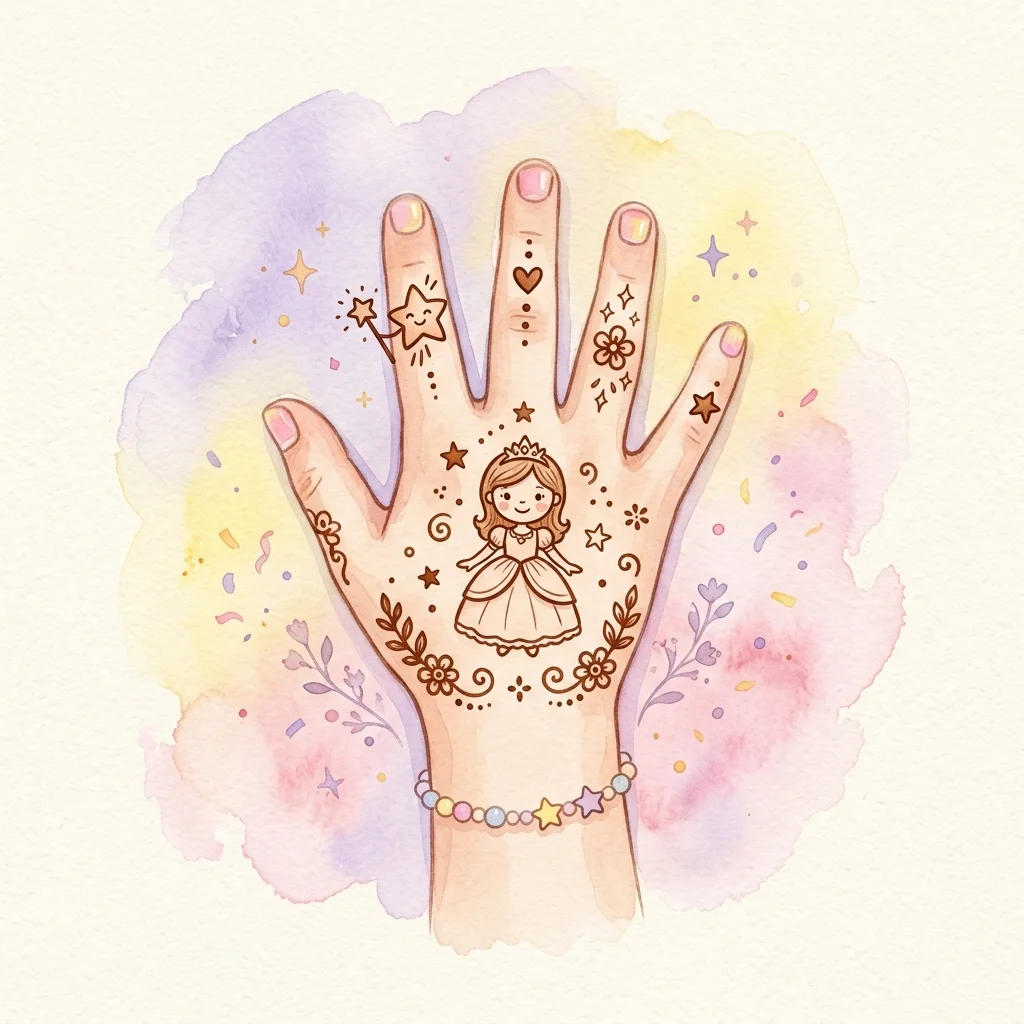
Magic Unicorn Mehndi Design
Learn to draw this easy Magic Unicorn mehndi design step by step. Perfect for 6-10 years — takes about 10-12 min.

How to draw it
Draw a pointed triangle for the horn, then sketch the unicorn's head in profile with a rounded snout, closed eye with tiny lashes, and a small smile.
From the back of the head, draw three to four curved lines cascading downward for the flowing mane. Each line should follow a gentle S-curve.
Scatter four to five small asterisk-shaped stars around the unicorn at varying distances to create a magical sparkle effect.
Add a small heart floating above the unicorn's head for a sweet, loving touch that balances the composition.
Finish with a curved vine of dots and leaves extending from below the unicorn toward the middle finger, tapering at the tip.
Practice This Design at Home
Print this worksheet and follow the step-by-step guide to master the design.
- ✓ Printable A4
- ✓ Beginner Friendly
- ✓ No Signup Required
Learn More About This Design
Complete guide, drawing tips, and safety profile
Why Kids Love This Design
Unicorns represent magic and imagination, and kids love the idea of a sparkling mythical creature on their hand. The closed eye and flowing mane give the unicorn a dreamy look. The scattered stars add a whimsical touch that makes children feel like they are carrying a piece of a fairy tale.
Design Profile
The Story & Tradition of Henna
An ancient art form representing happiness, blessings, and community
Crafted From Nature
Henna (or Mehndi) paste is made from the leaves of the Lawsonia inermis plant. The leaves are ground into a fine powder and mixed with water or tea to create a pure, skin-safe organic paste.
Symbols of Blessing
Traditional henna patterns are rich with symbolism. Circular mandalas represent wholeness, lines represent the path of life, and floral vines represent growth, health, and new beginnings.
Celebration & Joy
Across cultures, henna is applied during festivals, weddings, and family ceremonies. It is a social ritual where families gather, bond, and share wishes of good fortune and happiness.
Dos & Drawing Tips
- Start with the horn — it is a simple triangle and sets the position for the entire head.
- Keep the mane flowing in one direction. Three to four curved lines are enough; too many will look messy.
- Draw the stars as simple five-point shapes. Small stars can be just asterisk-like crosses.
- If the child has a small hand, skip the heart to keep the design from feeling crowded.
Common Mistakes
- Drawing the horn too short, which makes it look like a ear rather than a horn.
- Making the mane lines too straight instead of curved, losing the flowing look.
- Placing stars too close to the unicorn so they blend into the mane.
- Drawing the closed eye too large, which overwhelms the face.
More designs you might like


Frequently Asked Questions
Can I change the closed eye to an open eye?
Absolutely! Draw a small circle with a dot in the center for an open eye. An open-eye unicorn looks playful and alert, while a closed eye gives a calm, dreamy vibe. Let the child pick their favourite.
What if the stars look uneven?
Stars are one of the most forgiving elements in mehndi. Even uneven stars look charming. If you want more uniform stars, draw them as simple dots in a circular pattern instead of traditional star shapes.
Is this design suitable for boys too?
Of course! Unicorns are loved by all children. If a boy prefers, you can swap the heart for a small shield or star to give the design a different feel while keeping the same unicorn structure.